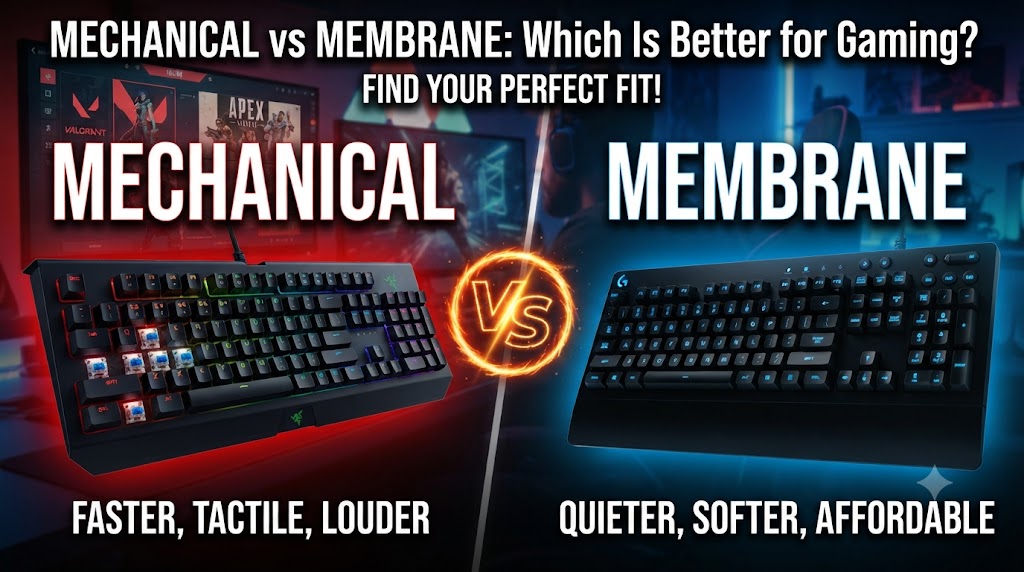
Mechanical vs Membrane Keyboard
Introduction
Mechanical and membrane keyboards use different technologies to register keystrokes. A mechanical keyboard uses individual mechanical switches underneath its keys, while a membrane keyboard uses a rubber or silicone membrane to register a key press. These designs affect how the keyboard feels, responds, sounds and performs during gaming.
For gaming, the choice depends on the type of games you play, how much you value fast and consistent key presses, and your budget. Mechanical keyboards are generally available with a wider variety of switches and gaming-oriented features, while membrane keyboards are often simpler and more affordable.
Quick Comparison Table
| Feature | Mechanical Keyboard | Membrane Keyboard |
|---|---|---|
| Key mechanism | Individual mechanical switches | Rubber/silicone membrane |
| Key feel | More defined | Softer |
| Response consistency | Generally more consistent | Depends on design and age |
| Key rollover | Often higher | Varies by model |
| N-key rollover | Common on gaming models | Less common |
| Durability | Generally higher | Generally lower |
| Customization | Usually extensive | Usually limited |
| Switch options | Many | Limited |
| Noise | Varies by switch | Usually quieter |
| Price | Usually higher | Usually lower |
| Gaming suitability | Excellent | Good for basic gaming |
| Maintenance | Switch/keycap options vary | Usually less repairable |
Mechanical vs Membrane Keyboard: How They Work
A mechanical keyboard has a separate physical switch under each key. When you press a key, the switch moves and sends the input to the computer.
A membrane keyboard uses a membrane layer and conductive contacts. Pressing a key pushes the membrane down until the contact registers the keystroke.
This difference gives mechanical keyboards their characteristic physical feedback and allows manufacturers to use different switch designs.
Advantage for mechanical design: Mechanical Keyboard
Mechanical vs Membrane Keyboard: Key Feel
Key feel is one of the most noticeable differences.
Mechanical keyboards can use linear, tactile or clicky switches. Linear switches generally provide a smooth press, tactile switches provide physical feedback during the key press, and clicky switches add an audible click.
Membrane keyboards generally have a softer, more uniform feel because the rubber dome or membrane provides the resistance.
For gaming, some players prefer the more defined and consistent feel of mechanical switches, while others prefer the softer action of a membrane keyboard.
Result: Depends on personal preference
Mechanical vs Membrane Keyboard: Gaming Response
A keyboard’s actual gaming response depends on several factors, including the switch mechanism, actuation point, firmware and connection.
Mechanical gaming keyboards commonly offer switches designed for fast actuation. Some modern mechanical gaming keyboards also offer adjustable actuation points or other advanced input features.
Membrane keyboards can work perfectly well for everyday gaming, but they generally provide fewer advanced options for adjusting the key actuation experience.
Advantage: Mechanical Keyboard
Mechanical vs Membrane Keyboard: Key Rollover
Key rollover describes how many simultaneous key presses a keyboard can correctly detect.
This can matter in games where several keys need to be pressed at once. Gaming mechanical keyboards commonly offer high key rollover or N-key rollover.
Membrane keyboards vary considerably. Some gaming membrane models provide adequate rollover for gaming, while basic keyboards can have more limitations.
Therefore, it is better to check the specifications of the individual keyboard instead of assuming every mechanical keyboard or membrane keyboard behaves identically.
Advantage: Mechanical Keyboard, generally
Mechanical vs Membrane Keyboard: Durability
Mechanical keyboards are generally designed around individual switches that can withstand a large number of keystrokes. Many mechanical switches are rated for tens of millions of actuations, although the exact rating depends on the switch.
Membrane keyboards can also last for years, but their rubber domes and membrane components can wear over time.
A mechanical keyboard also offers more opportunities for replacing individual keycaps and, on some models, switches.
Advantage: Mechanical Keyboard
Mechanical vs Membrane Keyboard: Customization
Mechanical keyboards offer significantly more customization.
Depending on the model, users can change keycaps, switches and sometimes stabilizers. Some keyboards also allow extensive software customization for lighting, macros and key assignments.
Membrane keyboards usually offer fewer hardware customization options.
For someone who enjoys building or modifying a gaming setup, mechanical keyboards provide considerably more flexibility.
Advantage: Mechanical Keyboard
Mechanical vs Membrane Keyboard: Noise
Noise depends heavily on the keyboard design.
Clicky mechanical switches can be relatively loud, while tactile and linear switches can be quieter. Mechanical keyboards can also produce additional sound from the keycaps and case.
Membrane keyboards are generally quieter and softer when keys are pressed.
This can make a membrane keyboard more suitable for shared rooms or situations where keyboard noise is undesirable.
Advantage for quieter operation: Membrane Keyboard
Mechanical vs Membrane Keyboard: Gaming Performance
Mechanical keyboards have become particularly popular among gamers because they combine consistent physical switches, different actuation characteristics and gaming-oriented features.
However, a mechanical keyboard does not automatically make someone a better gamer. Player skill, game settings, connection, mouse performance and other equipment also affect gaming performance.
A good membrane keyboard can still provide a perfectly usable gaming experience, especially for casual gaming.
Advantage: Mechanical Keyboard
Mechanical vs Membrane Keyboard: Typing and Everyday Use
A mechanical keyboard can be enjoyable for both gaming and typing because users can choose a switch type that matches their preferred feel.
A tactile switch may suit someone who wants noticeable feedback, while a linear switch may be preferred for a smoother press.
Membrane keyboards can be comfortable for general typing as well, particularly for users who prefer softer keys and lower noise.
Result: Depends on preference
Mechanical vs Membrane Keyboard: Price
Membrane keyboards are generally available at lower prices, making them attractive for users who want a basic keyboard without spending much.
Mechanical keyboards cover a wide price range. Basic mechanical models can be relatively affordable, while premium models with advanced switches, wireless connectivity and customization can cost considerably more.
Therefore, the price difference depends on the particular models being compared.
Advantage for lower initial cost: Membrane Keyboard
Mechanical vs Membrane Keyboard: Which Is Better for Competitive Gaming?
Competitive gamers often value consistent key presses, fast actuation and reliable simultaneous-key detection.
Mechanical gaming keyboards commonly offer these features, along with switch choices designed for different gaming preferences.
However, the actual specifications of the keyboard matter. A basic mechanical keyboard is not automatically better for competitive gaming than every membrane keyboard.
Advantage: Mechanical Keyboard
Mechanical vs Membrane Keyboard: Which One Should You Choose?
Choose a Mechanical Keyboard if:
- You play games regularly.
- You want a more defined key feel.
- You want different switch options.
- You want high rollover or N-key rollover.
- You want extensive customization.
- You want a keyboard that can serve gaming and typing needs.
- You are comfortable paying more for additional features.
Choose a Membrane Keyboard if:
- You want a lower-cost keyboard.
- You prefer softer keys.
- You want quieter operation.
- You mainly play casual games.
- You do not need extensive customization.
- You want a simple keyboard for everyday use.
Overall Winner: Mechanical Keyboard
For gaming, the mechanical keyboard has the broader set of advantages. It offers individual switches, a wider range of key feels, strong rollover options on many gaming models, greater customization and generally stronger long-term hardware options.
The membrane keyboard still makes sense for users who prioritize lower cost, quieter operation and a softer typing experience.
Conclusion
The choice between a mechanical and membrane keyboard ultimately depends on how you use your keyboard. A mechanical keyboard is generally more suitable for dedicated gamers who want consistent key feel, customization and gaming-focused features.
A membrane keyboard remains a practical choice for casual gamers and users who want a quieter and more affordable keyboard. Before buying, compare the actual switch, rollover, connectivity and feature specifications of the models you are considering.
Disclaimer
Keyboard performance and durability vary between individual models. Mechanical keyboards can use different switch types, and membrane keyboards can also differ in key feel, rollover and construction. Prices, specifications and available features may change over time, so check the current product specifications and local price before purchasing.